Guides
Low Voltage Landscape Lighting in Florida: How It Works
The transformer, cable and fixtures in a 12-volt system, how to size and place them in a Tampa Bay yard, and what Florida's plug-in exemption covers.
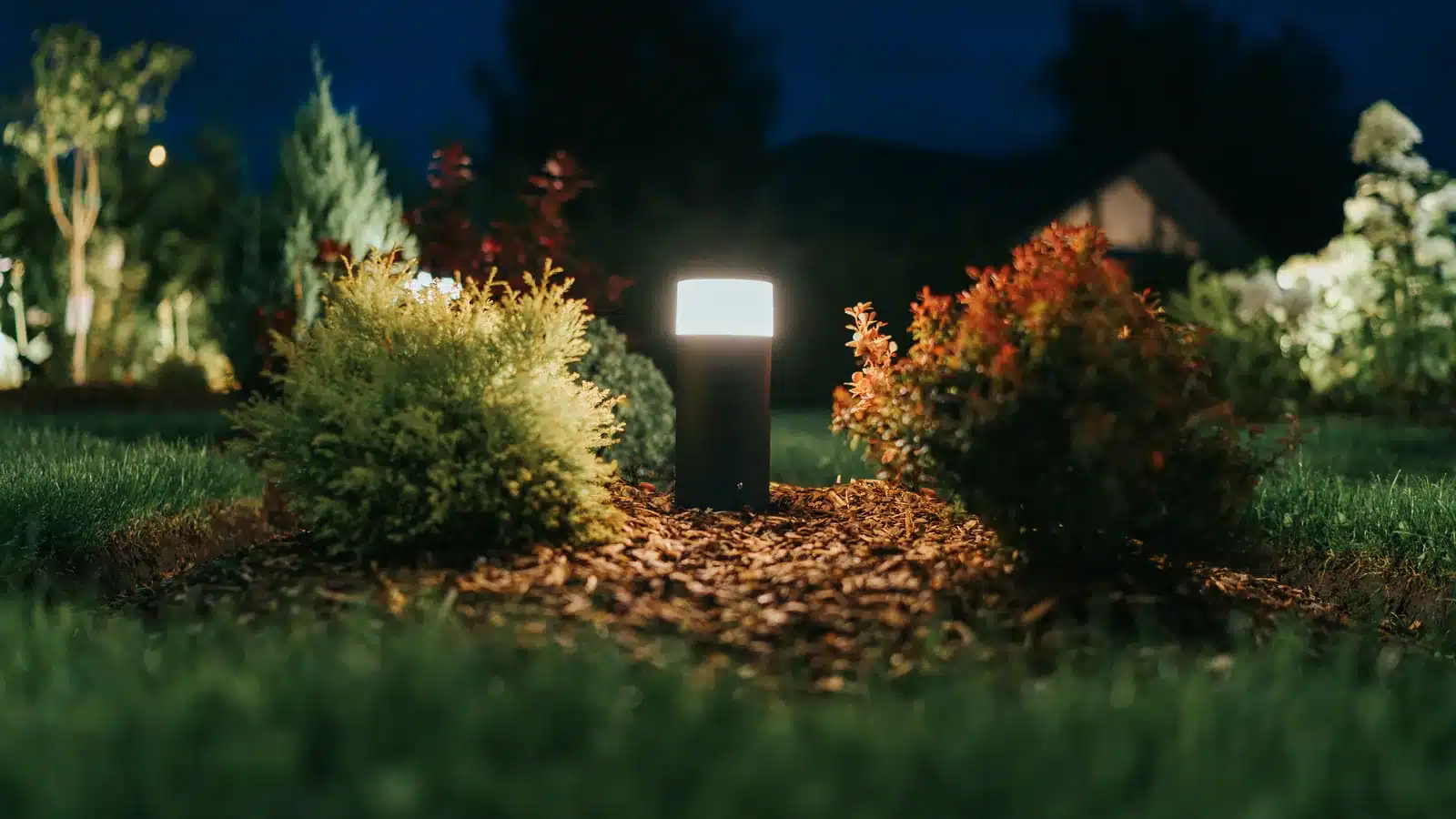
Low voltage landscape lighting runs outdoor fixtures on about 12 volts instead of household current. A transformer near an outdoor outlet steps the power down and sends it through cable in the beds to each light. In Florida, the electrical contracting law exempts anyone who installs a low-voltage system with a factory-installed cord and plug, as long as the job changes none of the building’s wiring. Medscapes designs and installs landscape lighting across Tampa Bay with Garden Light and VOLT fixtures.
How does a low voltage landscape lighting system work?
A low-voltage system is built from a transformer, cable, fixtures and the connectors that join them. The transformer takes household power and steps it down to the low voltage the fixtures run on. Cable runs out from the transformer through the beds, and each fixture’s lead is spliced onto that cable.
| Part | What it does | What to check |
|---|---|---|
| Transformer | Steps household power down to low voltage | Wattage above the fixtures’ total VA |
| Voltage taps | Outputs of 12 to 15 volts on one transformer | Higher tap for a longer run |
| Cable | Carries power from the transformer to the fixtures | Gauge and length of each run |
| Connectors | Join each fixture lead to the cable | Tight, sealed splices |
| Controls | Photocell, mechanical or digital timer, or Wi-Fi | Daylight saving changes |
Of the controls Kichler lists, a digital timer that adjusts for daylight saving time saves a reset twice a year (Kichler, Calculating Your Project Load Size).
Do you need a license to install low voltage lighting in Florida?
For a plug-in system, Florida’s electrical contracting law does not require one. Section 489.503 of the Florida Statutes lists who that licensing law does not apply to, and item (24) covers a person who installs low-voltage landscape lighting with a factory-installed electrical cord and plug that needs no installation, wiring or other change to the electrical wiring of a structure (Florida Statutes, section 489.503, 2025).
The exemption is narrow. A job that adds an outlet, hard-wires a transformer or changes the house wiring falls outside the exemption, so check what your own job needs before anyone starts. VOLT’s guide goes further for 120-volt fixtures and says line-voltage lighting must be installed by a licensed electrician.
This is general information about Florida’s electrical contracting exemption, not legal advice. Check the current statute, or ask your county or city building department, before you rely on it.
How big a transformer does your yard need?
Add up the VA of every fixture, then choose a transformer rated at or above that total. Kichler gives the example of a 300 VA system, which needs a transformer of at least 300 watts, and tells installers to list each fixture’s wattage and VA from its specification sheet (Kichler).
Leave room to grow. VOLT’s guide advises choosing a transformer with enough capacity for future additions, so a fixture added for a new bed next spring does not mean replacing the box (VOLT, How to Install Landscape Lighting).
Rather have the fixtures, transformer and cable runs planned for you? Ask Medscapes about a night lighting demo.
How far can low voltage cable run before the lights dim?
No single distance applies, because the answer depends on the load on the run and the cable’s gauge. Voltage falls along the cable, so the last fixture on a long, heavily loaded run gets less than the first and glows dimmer. Kichler’s formula for that loss is twice the cable length times the total VA on the run, divided by the cable’s constant, and the voltage left at the last fixture should be above 10 volts (Kichler).
If the math lands under 10 volts, Kichler gives three fixes: move the run to a higher voltage tap, take fixtures off the run, or use heavier cable. VOLT’s guide puts it in practice: the 12-volt tap for shorter runs with fewer fixtures, the 15-volt tap for longer runs that draw more power (VOLT). Kichler also recommends confirming the numbers with a voltmeter at the fixtures.
Where should the transformer go?
Put it where its own instructions say, because the makers disagree. Kichler places the transformer within 8 feet of a standard GFCI outlet, ideally on its own breaker circuit, and at least 10 feet from any pool or pond (Kichler). VOLT’s guide asks for at least 30 feet from any water feature, a foot of clearance around the box and a surface that can take its heat (VOLT).
A Tampa Bay yard with a pool cage, a pond or a fountain may give you only one wall that meets the distance. Find that wall before you buy fixtures.
What fails first in Florida’s wet weather?
Connections fail first. VOLT’s guide says a fixture that will not turn on usually points to a loose or poorly made wire connection, so check the splice at that fixture before you blame the transformer or the bulb. The same guide suggests clamp-connect junctions to protect splices from moisture and corrosion, which earns its keep through a Florida rainy season.
The fixture body matters next. VOLT’s guide says solid brass or copper construction resists corrosion far better than aluminum. After a storm in hurricane season, walk the yard at night and look for fixtures knocked out of aim or pulled loose from their cable.
When should you hire low voltage lighting out?
A small kit along one walk suits a homeowner willing to dig and splice; VOLT’s guide says low-voltage lighting is designed for do-it-yourself installation. Hire it out when the plan grows past one run, when a pool or pond limits where the transformer can go, or when the job needs any change to the house wiring, which takes it outside the Florida exemption. Design is the part a kit cannot supply: which features get light, and how few fixtures can do it.
Medscapes designs and installs landscape lighting with Garden Light and VOLT fixtures, and offers night lighting demos so you can see the effect before you decide. Doug Wilson walks the yard and writes every quote himself. For placement ideas, read our guide to landscape lighting ideas, and for the wider service, see our landscaping services in Tampa Bay.
The one thing to do this week: add up the VA on the fixtures you have, or plan to buy, and check it against the wattage printed on your transformer.
Frequently asked questions
How deep does low voltage landscape lighting need to be buried?
Your local electrical code sets the depth, and VOLT’s installation guide tells installers to dig to the depth that code requires. This guide gives no single figure because the code where you live decides it. Ask your county or city building department.
What should you look for in low voltage landscape lights?
Look for a system sized for its load, with fixtures that survive the weather. VOLT’s guide favors solid brass or copper fixture bodies over aluminum for corrosion, and a transformer with spare capacity. ENERGY STAR describes LEDs as directional light sources, which makes them easier to aim at one feature (ENERGY STAR).
Can I add lights to an existing low voltage system?
Add lights only if the new total VA stays at or under the transformer’s wattage, Kichler’s sizing rule. Each fixture you add to a run also lowers the voltage at the last fixture, so recheck the run.
Are low voltage landscape lights safe in the rain?
VOLT’s guide says a 12-volt system carries minimal risk of electrical shock, and VOLT designs it for homeowner installation. Place the transformer with care: Kichler puts it near a GFCI outlet, and both makers set a minimum distance from water.
Sources
- The Florida Senate. 2025 Florida Statutes, section 489.503, Exemptions. Checked October 28, 2026. flsenate.gov
- Kichler Lighting. Calculating Your Project Load Size (maker’s contractor guide). Checked October 28, 2026. kichler.com
- VOLT Lighting. How to Install Landscape Lighting: Step-by-Step Guide (maker’s guide). Checked October 28, 2026. voltlighting.com
- ENERGY STAR. Learn About LED Lighting. Checked October 28, 2026. energystar.gov
Want your lighting planned and installed for you?
Call (813) 382-5801 or send the estimate form. Ask about a night lighting demo; Doug Wilson walks the yard and writes the quote himself.
- 1Call or book online
- 2Doug walks the yard with you
- 3You get a written quote