Guides
Landscape Lighting Ideas for Palms, Facades and Paths
Where uplights, path lights and facade washes go on a Florida front yard, how to light a palm without cutting it back, and how to keep the glow off the neighbors.
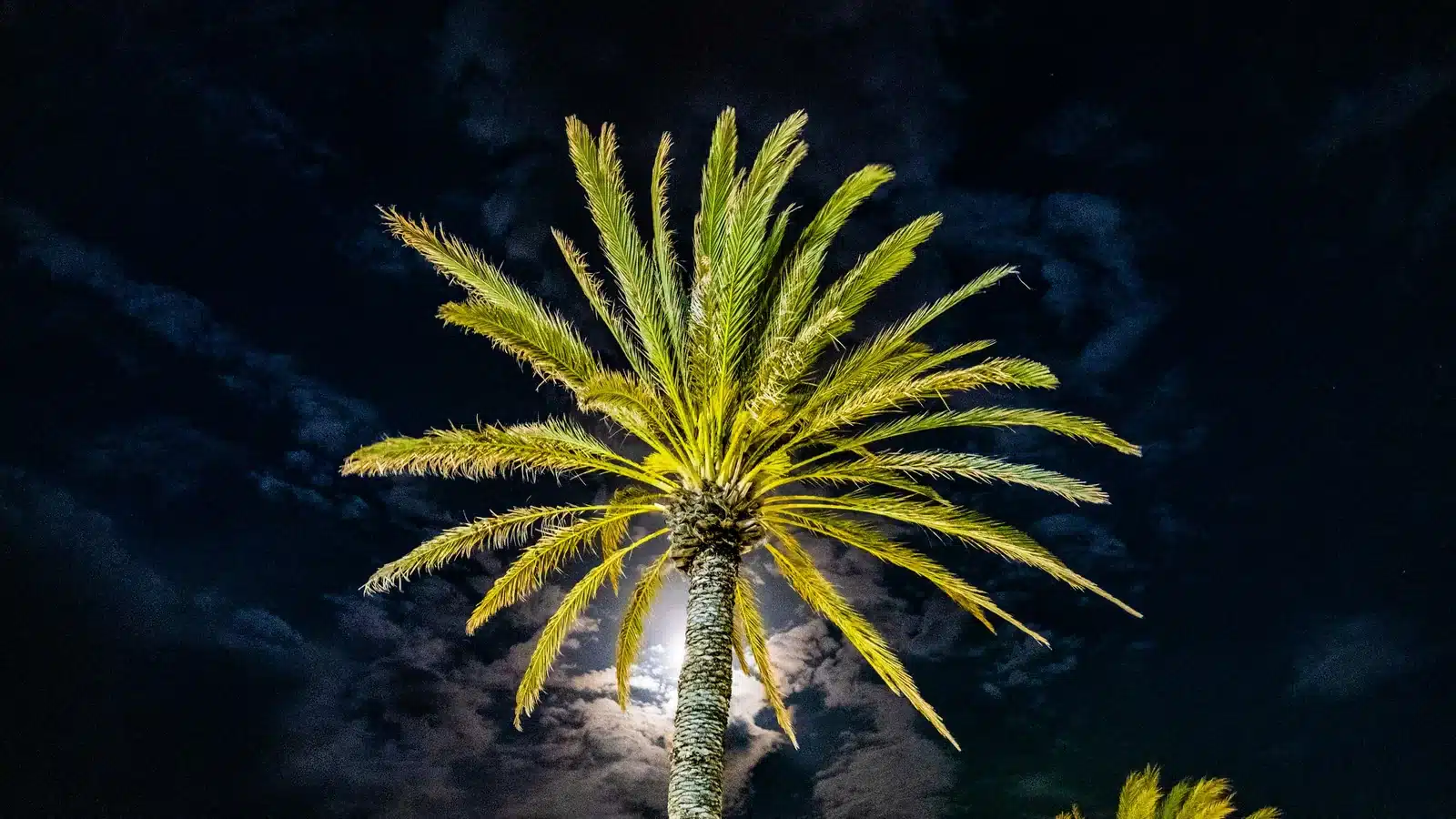
The landscape lighting ideas that work best on a Tampa Bay front yard come down to three: uplights at the base of a palm or shade tree, a soft wash across the front of the house, and low path lights that pool light on the walk to the door. Add moonlighting if a big tree spreads over the yard. Keep the fixtures few, low and aimed away from windows and the street. Medscapes designs and installs landscape lighting with Garden Light and VOLT fixtures.
Which landscape lighting ideas suit a Florida front yard?
Pick the two or three things you want to see from the street after dark, and light only those. On most Tampa Bay fronts that means a palm or a shade tree, the face of the house, and the walk to the door. Each one takes a different technique, and the table shows where each fixture goes.
| Technique | Where the fixture sits | Best for | Watch for |
|---|---|---|---|
| Uplighting | At the base, aimed up the trunk | Palms, specimen trees | Beams that run past the crown into the sky |
| Washing | A few feet out from a wall, wide beam | Stucco house fronts | Bright spots on windows |
| Grazing | Tight to the wall, aimed straight up | Stone, brick, rough stucco | Every patch on a smooth wall |
| Path lighting | Low fixtures, staggered along the walk | Walks, steps, turns | A straight double row |
| Moonlighting | High in a tree, aimed down | Big shade trees over a lawn or patio | Spill into a neighbor’s yard |
| Silhouetting | Behind a plant, aimed at the wall | Palms and shrubs with a strong outline | Needs a pale wall close behind |
For a wider plan that ties the lighting to new beds, paths or a patio, start with landscape design in Tampa, so the fixtures go in where the plants and paving will be.
How do you uplight a palm tree?
Set the fixture at the base of the trunk, a short step out, and aim it up so the light climbs the trunk and catches the underside of the fronds. A single-trunk palm usually needs one fixture. A clumping palm with several trunks looks fuller lit from two sides, so the trunks do not cast one flat shadow.
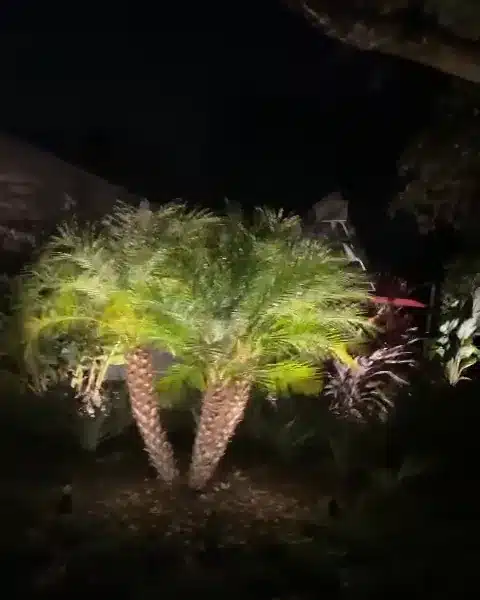
Do not cut a palm back to show off the light. UF/IFAS palm researcher Timothy Broschat writes that “no leaves with tips above the horizontal plane (9:00 and 3:00 positions on a clock face) should be removed,” and that after the 2004 and 2005 Florida hurricanes, hurricane-cut palms “were more likely to have their crowns snapped off” (Pruning Palms, EP443). If a low frond blocks the beam, move or re-aim the fixture.
How should you light the front of a house?
Wash it with soft, even light. Set wide-beam fixtures a few feet out from the wall and aim them across it at a low angle, so the light spreads over the stucco in a smooth sheet. Keep the beams off the windows, because light on glass glares back at the street and shines into the rooms.
Grazing suits a textured wall. Put the fixture tight to the base and aim it straight up, and stone or rough stucco throws its own small shadows. On a smooth wall, grazing shows every patch and crack, so wash that wall instead.
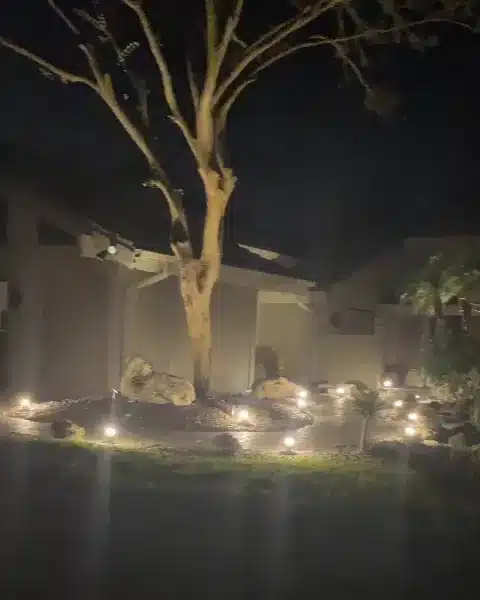
Want to see these ideas on your own house before you choose? Ask Medscapes about a night lighting demo.
How do you light a path without making a runway?
Stagger low fixtures on alternate sides of the walk, spaced so each pool of light just meets the next. A straight double row on both edges looks like an airport runway and lights the walk less evenly than a staggered line. Put the first fixtures where the footing changes: a step, a turn, the edge of the drive.
Height matters as much as spacing. A short fixture that throws its light down keeps the glow on the ground, where your feet need it, and out of the eyes of a guest walking to the door.
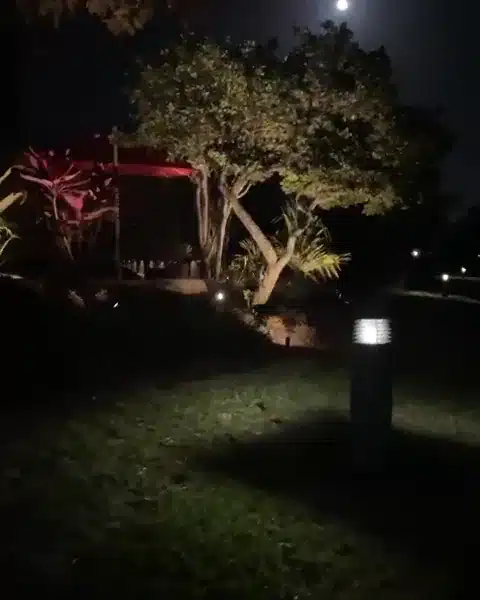
What is moonlighting, and when does it fit?
Moonlighting puts a fixture high in a tree and aims it down through the branches, so the ground below gets soft, dappled light, as if from a full moon. It suits a large shade tree over a lawn, a patio or a driveway, and it lights the area under the tree with no fixture at eye level.
Medscapes lists moonlighting among its lighting work, beside path, palm and facade lighting. Because the fixture sits up in the canopy, check its aim after a storm and after anyone prunes the tree.
How do you keep landscape lighting from glaring at the neighbors?
Aim each fixture at a feature, keep the beam below eye level from the street, and use fewer fixtures than you first planned. UF/IFAS Extension Sarasota County’s advice for wildlife-friendly lighting is to keep it “low, long, and shielded”: fixtures mounted low to the ground, warm amber or orange light, and bulbs shielded so they are not exposed (Turn off the Lights for Nature at Night). The same post suggests switching off lights you are not using, or using motion-activated lights where you need them.
LEDs are directional light sources: they emit light in a specific direction, where incandescent and compact fluorescent bulbs send light and heat in all directions. ENERGY STAR adds that LED lighting products make light up to 90% more efficiently than incandescent bulbs.
The honest limit: two well-aimed uplights and a lit walk often look better than a fixture in every bed, and they cost less to buy and run. Start small and add a fixture only where the yard still feels dark.
What upkeep does landscape lighting need in Tampa Bay?
Walk the yard after dark a few times a year and fix what has drifted. In the rainy season, shrubs and ornamental grasses grow fast enough to bury path lights and block uplights by late summer, so trim around the fixtures when you trim the beds. After a storm in hurricane season, look for fixtures knocked out of aim or covered by mulch and debris.
Wipe the lenses while you are down there. Dirt and sprinkler spray spots dim the light long before a fixture fails. For help with the beds, the lighting or both, see our landscaping services in Tampa Bay.
The one thing to do this week: walk your yard after dark with a flashlight and note the two or three things you would want to see from the street. Light those first.
Frequently asked questions
What is the best type of landscape lighting for a front yard?
For most front yards, the best mix is one or two uplights on the strongest feature, a soft wash on the house and low path lights on the walk. The yard decides which feature leads: a palm, a shade tree or the house itself. LED fixtures make the aiming easier, because ENERGY STAR describes LEDs as directional light sources.
What are the most common outdoor lighting mistakes?
Too many fixtures, beams aimed at windows or the street, and path lights in a straight double row are the mistakes that show most from the curb. Lighting everything to the same brightness is another, because it flattens the yard. Light one or two features brighter than the rest and let the beds between them stay dark.
Should landscape lights go in front of or behind shrubs?
Put an uplight in front of a shrub or tree to show its color and texture, and behind it to show its outline against a pale wall, which is called silhouetting. Silhouetting works only with a wall close enough to catch the light. In front, tuck the fixture low in the bed so you see the light and not the fixture.
Sources
- UF/IFAS Extension. Pruning Palms (ENH1182/EP443), Timothy K. Broschat. Checked October 19, 2026. ask.ifas.ufl.edu
- UF/IFAS Extension Sarasota County. Turn off the Lights for Nature at Night, Jackie Lebouitz and Zahir Ringgold Cordes. Checked October 19, 2026. blogs.ifas.ufl.edu
- ENERGY STAR. Learn About LED Lighting. Checked October 19, 2026. energystar.gov
Want to see your yard lit before you decide?
Call (813) 382-5801 or send the estimate form. Ask about a night lighting demo; Doug Wilson walks the yard and writes the quote himself.
- 1Call or book online
- 2Doug walks the yard with you
- 3You get a written quote